

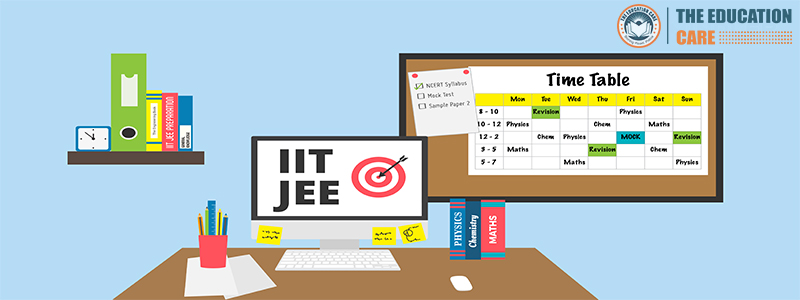
IIT JEE
The JEE Main exam is anticipated to be administered in two sessions by the National Testing Agency, which will administer IIT JEE. The organization in charge of administering the exam will make the JEE Main application form available on the official website (jeemain.nta.nic.in). Candidates can check their eligibility for JEE Main by visiting this page. IIT JEE will probably take place over two sessions.
JEE Main 2023 Age Requirement:
- Candidates who are born on or after October 1, 1998, are eligible to attempt JEE Main 2023.
- SC/ST/PWD candidates have 5-year age relaxation.
The DOB on the candidate's higher secondary education certificate will be considered.
JEE Main 2023 Academic Qualification:
- Applicants should pass 10+2 or an equivalent exam from a government-recognized board in the year 2022/2023.
- Candidates who attempted the 12th class exam in 2020 but have not passed the exam are not eligible to take the exam again.
- Physics, Chemistry, and Mathematics are mandatory subjects in Class 12th.
NTA has removed the minimum criteria of 75% eligibility for JEE Main.
Changes in JEE Main 2023 Exam Pattern
- Instead of Papers I and I, there will be a different paper for B.E/B. Tech, B.Arch, and B.Planning.
- The exam will include 90 questions from the B.E/B. Tech paper, 82 questions from the B.Arch paper, and 105 questions from the B.Planning paper.
- There will be two types of questions on the exam, MCQs and numerical value questions.
JEE Syllabus for JEE Main
Candidates must study the mentioned topics below for JEE 2023 Syllabus for JEE Main.
- Physics: Kinetic theory of gases, Electromagnetic waves, Rotational motion, Properties of solids and liquids, Gravitation, Kinetic theory of gases, Oscillations, and Waves, Electrostatics, Dual nature of matter and radiation, Current electricity, Magnetic effects of current and magnetism, Electrostatics, Work, power and energy, etc.
- Chemistry: General principles and processes of isolation of metals, Purification, and characterization of organic compounds, Hydrocarbons, Organic compounds, Classification of elements and periodicity in properties, Polymers, Block elements (alkali and alkaline earth metals), Block elements group 13 to group 18 elements, D-block elements and f-block elements, General principles, and processes of isolation of metals, Surface chemistry, Equilibrium, Chemical bonding, Redox reactions, and electrochemistry, etc.
- Mathematics: Sets, Relations, and Functions, Permutations and combinations, Matrices and determinants, Mathematical induction, Mathematical reasoning, Integral calculus, Continuity and differentiability, Sequences and series, Coordinate geometry, Three-dimensional geometry, Trigonometry, Vector algebra, etc.
JEE Advanced Eligibility Criteria
Candidates have to check the eligibility criteria for JEE Advanced 2023 before applying for JEE Advanced:
- Nationality: All Indian nationals will be eligible to apply for JEE Adv. Foreign candidates are eligible under 10% of the SNQ.
- Age Limit: The aspirants from the General & OBC categories should be born on or after October 1, 1998. Five years of age relaxation is provided for SC/ST/PwD candidates.
- Academic Qualification: Candidates should pass the Class XII examination for the first time in the year.
- Subject: Physics, Chemistry & Mathematics (PCM) should be mandatory subjects in Class 12th.
- Number of Attempts: A candidate can attempt two times in two consecutive years.
JEE Main Performance: The candidates rank among the top 2.5 lakhs JEE Main rankings to attempt JEE Advanced.
JEE Advanced Syllabus
The main topics included in the JEE Advanced syllabus exam are given subject-wise below:
Physics: Units and dimensions, Kinematics, General Physics, Mechanics, Electricity and magnetism, Optics, Thermal Physics, Modern physics, etc.
Chemistry: General topics, Gaseous and liquid states, Atomic structure and chemical bonding, Energetics, Chemical equilibrium, Transition Elements, Surface Chemistry, Extractive Metallurgy, Electrochemistry, Nuclear Chemistry, Chemical kinetics, Solid-state, Preparation, Properties, and Reactions of Alkane, Alkenes, Alkynes, etc.
Mathematics: Algebra, Trigonometry, Matrices, Analytical geometry, Differential calculus, Integral calculus, Vectors, Probability, etc.
Conclusion
A prestigious engineering entrance exam, known as JEE, is given at the national level in India. To gain admission to India's top engineering schools, applicants take this exam. The IITs, NITs, CFITs, and other esteemed engineering institutions admit those who pass the exam to some of the best technical and engineering programs in the nation.
NEET
The National Testing Agency (NTA) administers the National Eligibility cum Entrance Test (NEET), a national-level medical entrance examination for undergraduate admissions to MBBS, dental, AYUSH, and nursing programs in India. The exam serves as an entry point to some of the best medical schools in the nation, including AIIMS and JIPMER. The NEET is a paper-and-pencil test available in 13 languages. Based on the curricula for Classes 11 and 12, the NEET syllabus will be the same and cover Physics, Chemistry, and Biology.
NEET Eligibility
Read below the primary eligibility criteria required to sit in NEET UG.
- The minimum age requirement to appear in NEET is 17 years during admission or before December 31. Therefore, students born on or after December 31, 2006, are eligible. The upper age limit for General category candidates is 25 years, and for other categories, it is 30 years.
- Applicants of the general category must have passed Class 12 in PCB and English from a recognized board with a minimum of 50% marks, which is 45% for PWD and 40% for OBC/SC/ST categories.
- Students should be Indian Nationals, NRIs, OCIs, PIOs, or Foreign Nationals.
JEE Main Performance: The candidates rank among the top 2.5 lakhs JEE Main rankings to attempt JEE Advanced.
NEET Application Form
NTA will release the NEET application form on its official website- neet.nta.nic.in., and candidates can start registering from the first week of April 2023 (tentatively).
Steps to Fill NEET 2023 Application Form
- Visit the official website of NTA NEET and click on the ‘New Registration’ tab.
- Fill in basic details like name, contact number, DOB, email, etc. and click submit.
- Your login credentials (ID and Password) will be created and registration completed.
- Start filling in the NEET application form by providing personal details, choosing the exam center and medium, and academic details.
- Now, upload the documents like passport-size photographs, academic certificates, category certificates, signatures, thumb impressions, etc. in JPG and PDF formats.
Pay the NEET application fee via UPI, debit card, credit card, net banking, or e-wallet.
CAT
A computer-based exam called the Common Admission Test (CAT) is required for enrollment in graduate management programs. Verbal Ability and Reading Comprehension, Data Interpretation and Logical Reasoning, and Quantitative Ability make up the three sections of the test. Online exams last three hours, with one hour allotted to each section. In 2020, the Indian Institutes of Management Indore decided to conduct the CAT Exam in 2 hours, with 40 minutes allotted to each section, to comply with COVID precautions. To select students for their business administration programs (MBA or PGDM), the Indian Institutes of Management established this exam. One of the Indian Institutes of Management administers the test annually according to a rotational scheduling policy.
Eligibility for CAT
The candidate must satisfy the below-specified criteria:
- Hold a bachelor's degree, with not less than 50% or equal CGPA (45% for Scheduled Caste (SC), Scheduled Tribe (ST), and Persons with Disability (PWD)/Differently Able (DA) classification)
- The degree should be granted by any of the universities consolidated by an act of the central or state statutory body in India or other instructive organizations built up by an act of Parliament or pronounced to be considered as a university under Section 3 of the UGC Act, 1956, or possess an equivalent qualification recognized by the Ministry of HRD, Government of India.
- Competitors appearing for the final year of the bachelor's degree/equivalent qualification examination and the individuals who have finished degree prerequisites and are anticipating results can likewise apply. If selected, such applicants will be permitted to join the program temporarily, only if they present a certificate most recent by June 30, 2020, from the principal/registrar of their college/institute (issued at the latest June 30, 2020) expressing that the competitor has finished every one of the prerequisites for acquiring four-year or three-year college education/identical capability on the date of the issue of the certificate.
Exam pattern
The Common Admission Test (CAT), like almost all substantial exams, makes use of various test formats. As a result, there are two different types of scores: a raw score and a scaled score.
The raw score is calculated for each section based on the number of questions one answered correctly, incorrectly, or left unattempted. Candidates are given +3 points for each correct answer and -1 points for each incorrect answer. No points are given for questions that are not answered. The raw scores are then adjusted through a process called equating. Equated raw scores are then placed on a common scale or metric to ensure an appropriate interpretation of the scores. This process is called scaling.
On a larger scale, 100 questions are in total in each section, so the total number of questions and the number of questions per section in the cat exam merely change. First, there are 34 questions in the verbal ability and reading comprehension section, which are further divided into 24 questions on reading comprehension and 10 questions on verbal ability. Then, there are 32 questions in the section on data interpretation and logical reasoning, and 34 questions in the section on quantitative ability, for a total of 100 questions. which had a change in 2020 because the number of questions on the paper was reduced.
CAT is conducted in two sessions.
Test pattern and duration
CAT's exact exam pattern changes every year. For CAT 2018, a mock test was supplied.
CAT is a computer-based test that consists of 3 sections:
- Verbal and Reading Comprehension
- Data Interpretation & Logical Reasoning
- Quantitative Ability
The Quantitative Ability and Verbal & Reading Comprehension sections consisted of 34 questions each, whereas the Data Interpretation & Logical Reasoning section had 32 questions. This distribution of questions was the same since CAT 2015. Before this, the distribution of questions was different.
There are various other exams like MAT, XAT, and many more.